Strategy

Why Starting Social Promotion From Your Newsletter Beats Starting From a Prompt

If you already wrote the newsletter, you already did the hard part. A newsletter-first workflow turns that finished issue into LinkedIn posts, X posts, subject lines, and quote snippets without rebuilding the same thinking from scratch.

L

Letterflow Editorial Team

July 22, 2026 · 5 min read
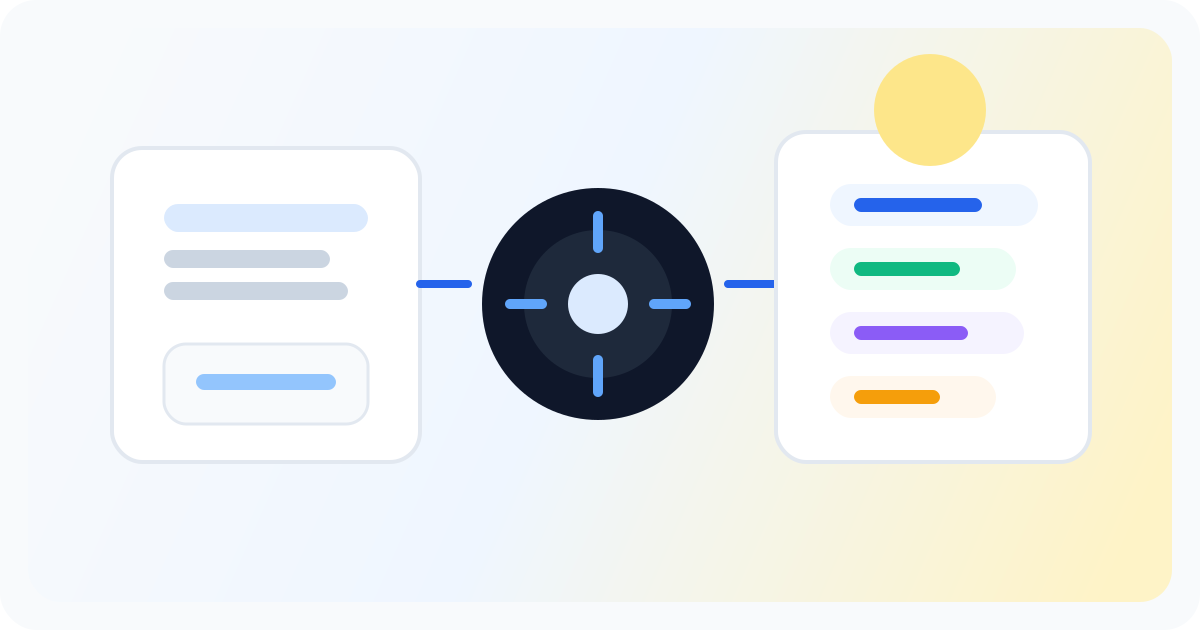
Editorial illustration showing a newsletter distribution strategy workflow across channels.

The short version

If your newsletter is already written, starting social promotion from a blank prompt is the wrong first move. You are not trying to invent new ideas every time. You are trying to extract the best parts of one finished issue and turn them into promotion that sounds like you, fits the platform, and gets out the door quickly. That is the practical case for a newsletter-first workflow. Letterflow is built around that exact sequence. You start from the real newsletter, generate repurposed drafts, edit the ones worth publishing, and schedule the result for LinkedIn and X. It is not a generic AI writer and it is not trying to replace your thinking. It is a repurposing layer for creators who already did the writing and now need distribution to happen without a second content job. That matters because most social tools assume the post already exists, or they assume the prompt is enough to create it. Newsletter writers live in the middle. The issue exists. The ideas exist. The voice exists. What is missing is the fast path from finished issue to platform-ready promotion.

  • Start from the newsletter, because that is the real source of the idea and voice.
  • Use repurposing to create LinkedIn and X drafts instead of rewriting the same argument three times.
  • Choose Letterflow when promotion follows writing; choose queue-first tools when social is the primary content system.

The fastest social promotion workflow is the one that starts from the work you already finished, not the blank box you still have to fill.

A practical workflow for newsletter-first promotion

The basic advantage is simple: a newsletter already gives you a complete input. It has a subject, a point of view, examples, a structure, and usually one or two lines that are worth pulling out on their own. When you feed that into a repurposing workflow, you are not asking an AI to invent the topic. You are asking it to reframe something you already decided was worth sending to readers. That usually produces better drafts, because the source is concrete instead of abstract. Letterflow’s workflow reflects that reality. You can generate LinkedIn posts, X posts, subject lines, and quote snippets from one newsletter issue. You can train a voice profile from your past posts and newsletters so the drafts feel closer to your own cadence. Then you can edit, regenerate, publish, and schedule LinkedIn and X posts in the same workspace. For newsletter writers, that is the useful sequence: source content first, social adaptation second, distribution last. This is especially useful for solo creators and founder-operators. If you are publishing weekly, you probably do not need a giant content system. You need a repeatable way to turn each issue into enough social promotion to make the send work harder. That may mean one strong LinkedIn post, a few X variations, and a subject-line-style hook you can reuse as a teaser. The point is not to create endless content. The point is to get one good idea to travel farther without spending the afternoon rebuilding it from zero.

Stop writing social posts from scratch

Letterflow turns one newsletter into a week of platform-ready content so your promotion starts with the writing you already trust.

Start free trial

Tradeoffs: when newsletter-first is the right call, and when it is not

  • Newsletter-first works best when the issue is already written and promotion is the next step. If you still need to decide what to say, a blank-prompt writer or a broader social ideation tool may be enough.
  • The fit is strongest for independent newsletter writers, founder-operators, and tiny teams publishing on a regular cadence. If you only send sporadically, the value drops because the repurposing rhythm is less repeatable.
  • Letterflow is good at repurposing from one source, but it is not trying to be a generic content engine. If your workflow is mostly LinkedIn-led or X-led and the newsletter is secondary, tools like Taplio or Hypefury may be a better match.
  • Queue-first social schedulers can still be the better option when your main job is calendar management, not source-to-social repurposing. They are broader, but they start later in the workflow.

Bottom line

If your newsletter is the real piece of work, it should also be the start of promotion. That is the cleanest way to save time without lowering quality. You are not asking a tool to create a strategy from thin air. You are asking it to help you move one finished issue into the channels where readers will actually see it. That is where Letterflow is a real recommendation. It fits when you want to repurpose a newsletter into social drafts, keep the voice close to your own, and schedule the result without stitching together a separate workflow. If your content system starts somewhere else, use something else. If the newsletter is the source, start there.

L

Letterflow Editorial Team

Newsletter growth and workflow research

The Letterflow editorial team researches newsletter workflows, creator operations, and repurposing systems so every guide stays practical.

Frequently asked questions

Common questions

What does newsletter-first social promotion actually mean?

It means the newsletter is the starting point for social distribution. Instead of opening a blank LinkedIn or X composer and inventing a new post, you use the finished newsletter as the source material and repurpose it into platform-specific drafts.

When is Letterflow a better fit than a normal social scheduler?

Letterflow is a better fit when you already have a newsletter issue and want to turn it into LinkedIn and X content quickly. A normal social scheduler is better when you already wrote the social posts and only need to queue them up.

Does Letterflow replace editing?

No. The workflow is repurpose, edit, publish, and schedule. The drafts are meant to save time and reduce blank-page friction, not to remove the need for judgment.

Who gets the most value from this workflow?

Independent newsletter writers, founder-operators, and small teams that publish regularly. They have the clearest source material and the most to gain from turning one issue into a week of promotion.